Choosing a Kitchen Benchtop
Five materials, compared on the things that actually go wrong: heat, stains, chipped edges, visible joins and what happens when a benchtop is damaged five years in.

How to read a benchtop schedule
A benchtop is specified as a set of lines, not a single choice. The material decides heat and stain behaviour. The thickness decides whether the top reads as a slab or a plane. The edge profile decides how it chips. The join positions decide what you look at every day.
Engineered stone, natural stone, porcelain and timber
Each of these arrives as a slab, is templated on site and is fabricated off site. What separates them is how they behave under a hot pan, a spilled red wine and a dropped saucepan.
Engineered stone
Consistent colour, predictable supply, non-porous so everyday spills sit on the surface. Handles stains well and takes a mitred edge cleanly. Direct heat is the weak point — trivets are not optional.
Natural stone
Marble, granite and quartzite carry veining no factory can repeat, which is the whole point. Porous to varying degrees, so sealing is part of ownership. Marble etches with lemon and vinegar; granite and quartzite are far harder wearing.
Porcelain
Fired sheet material, effectively non-porous and the most heat tolerant of the four. Thin, so it usually runs as a slim top or is built up at the edge. Pattern is printed on the face, which matters where the slab is cut.
Timber
The one material that can be sanded back and re-oiled rather than replaced. Warm underhand and forgiving of knocks. It moves with humidity and dislikes standing water, so it suits islands and dry runs more than a sink bench.
Laminate, thickness and the edge profile
Laminate has moved a long way: tight seams, matte textures and squared post-formed edges that no longer read as a compromise. The substrate is board, so the rule is simple — keep water out of the edges and the joins, and it performs for years. It is also the material that makes a layout change affordable when the money needs to go into cabinetry instead.
Joins, cutouts and living with it
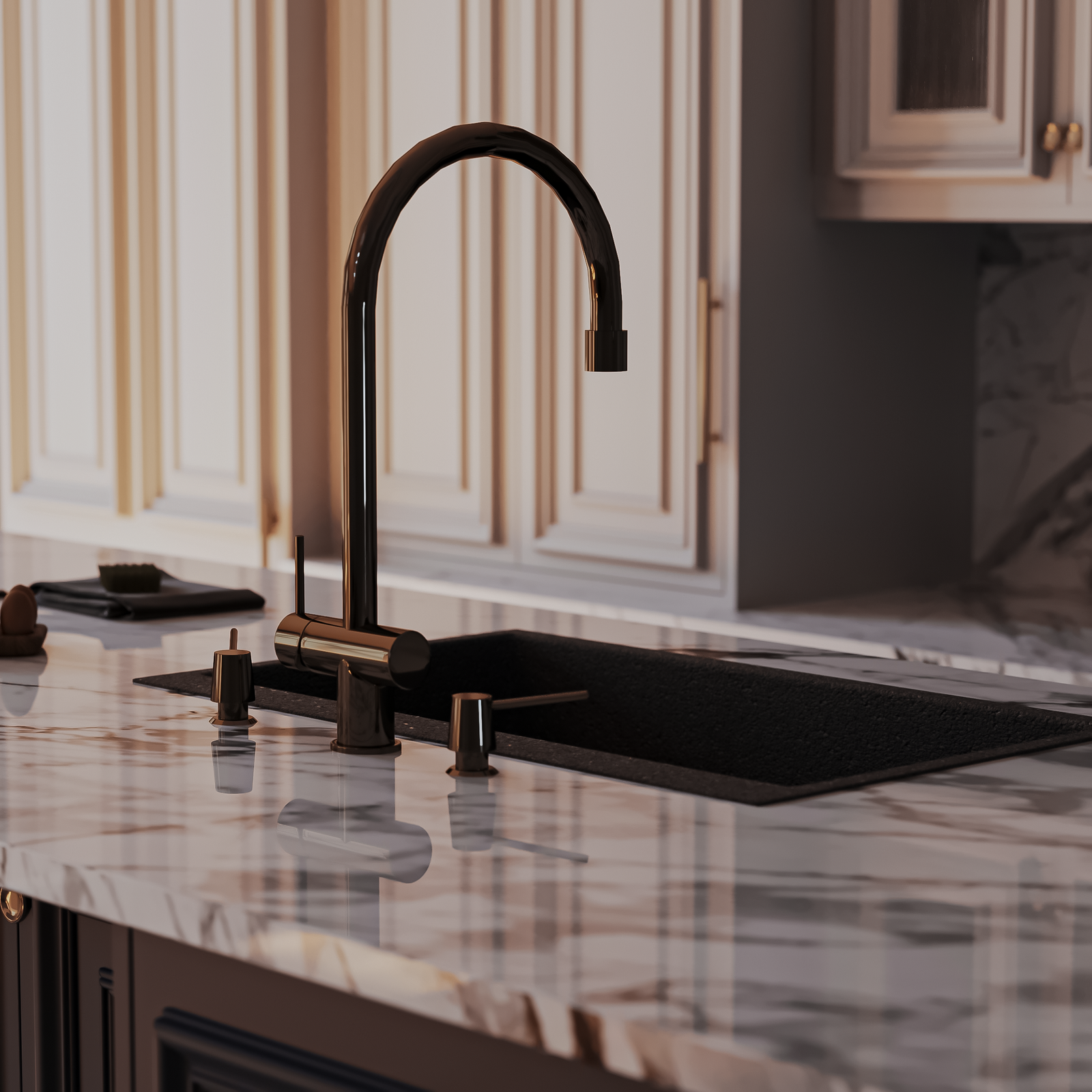
Slabs come in finite sizes, so most kitchens have at least one join. Ask where it will fall before the template is cut — a join tucked behind a cooktop or at an internal corner disappears; one across an open run of island never will. Cutouts are the other pressure point: tap holes, undermount sinks and cooktop openings are where chips start, and radiused internal corners hold up far better than square ones.