In this guide
01  How to read a benchtop schedule02  Engineered stone, natural stone, porcelain, timber03  Laminate, thickness and edge profile04  Joins, cutouts and daily care05  Questions for the fabricator
Home  /  Kitchen Guides  /  Choosing a Benchtop
Guide  ·  Materials & finishes

Choosing a Kitchen Benchtop

Decided firstMaterial and thickness — colour is the last line, not the first

Five materials, compared on the things that actually go wrong: heat, stains, chipped edges, visible joins and what happens when a benchtop is damaged five years in.

Order of decisionMaterial → thickness → edge profile → join positions → finish
Measured after cabinetryTemplating happens on installed carcasses, not on drawings
01  ·  Reading the schedule

How to read a benchtop schedule

A benchtop is specified as a set of lines, not a single choice. The material decides heat and stain behaviour. The thickness decides whether the top reads as a slab or a plane. The edge profile decides how it chips. The join positions decide what you look at every day.

Compare materials on the same five lines and the shortlist narrows quickly. The sections below run engineered stone, natural stone, porcelain, timber and laminate through heat, stain, repairability and joins — then set out what to confirm before a slab is cut. If you already know the direction you want, the scope itself sits on Kitchen Benchtops.
02  ·  The four slab materials

Engineered stone, natural stone, porcelain and timber

Each of these arrives as a slab, is templated on site and is fabricated off site. What separates them is how they behave under a hot pan, a spilled red wine and a dropped saucepan.

Engineered stone

Consistent colour, predictable supply, non-porous so everyday spills sit on the surface. Handles stains well and takes a mitred edge cleanly. Direct heat is the weak point — trivets are not optional.

Watch forHeat marks and silica handling rules with your fabricator

Natural stone

Marble, granite and quartzite carry veining no factory can repeat, which is the whole point. Porous to varying degrees, so sealing is part of ownership. Marble etches with lemon and vinegar; granite and quartzite are far harder wearing.

Watch forEtching, sealing intervals, slab-by-slab selection

Porcelain

Fired sheet material, effectively non-porous and the most heat tolerant of the four. Thin, so it usually runs as a slim top or is built up at the edge. Pattern is printed on the face, which matters where the slab is cut.

Watch forExposed core at cut edges; chipping at sink cutouts

Timber

The one material that can be sanded back and re-oiled rather than replaced. Warm underhand and forgiving of knocks. It moves with humidity and dislikes standing water, so it suits islands and dry runs more than a sink bench.

Watch forWater at the sink and dishwasher vent; annual re-oiling
03  ·  Sheet material and edges

Laminate, thickness and the edge profile

Laminate has moved a long way: tight seams, matte textures and squared post-formed edges that no longer read as a compromise. The substrate is board, so the rule is simple — keep water out of the edges and the joins, and it performs for years. It is also the material that makes a layout change affordable when the money needs to go into cabinetry instead.
It is the usual choice in a kitchen makeover, where doors, benchtop and hardware change but the layout stays put.
Thickness20 mm reads as a plane; mitred to 40 mm reads as a slab
Edge profileA pencil round survives trolleys and hips; a sharp arris does not
Waterfall endCosts a second slab section and asks for veining to be matched around the mitre
OverhangPast about 300 mm, seating overhangs need concealed support
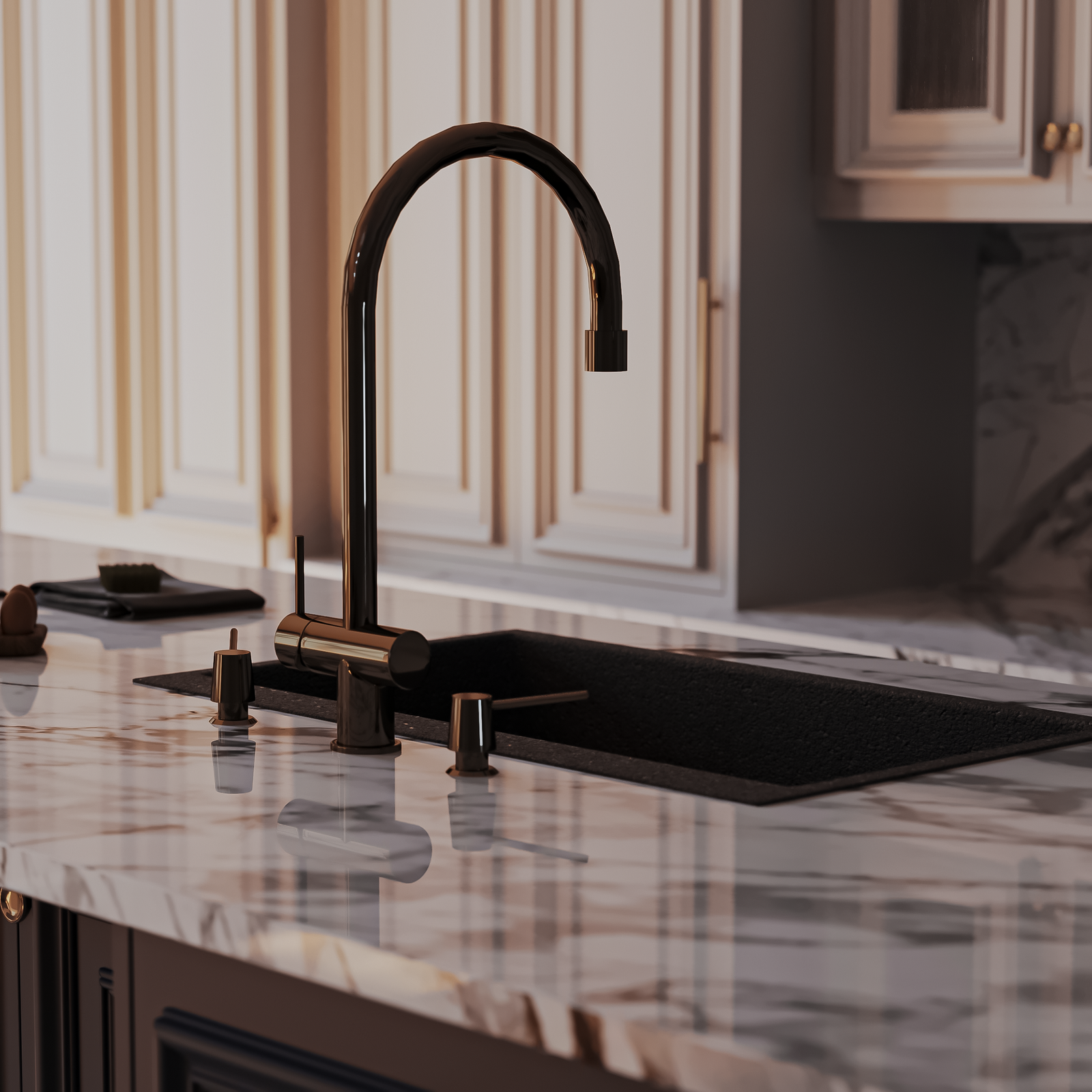
Close-up of a tall black gooseneck kitchen faucet with matching controls beside a dark sink set into a veined marble benchtop.
04  ·  Joins, cutouts and care

Joins, cutouts and living with it

Slabs come in finite sizes, so most kitchens have at least one join. Ask where it will fall before the template is cut — a join tucked behind a cooktop or at an internal corner disappears; one across an open run of island never will. Cutouts are the other pressure point: tap holes, undermount sinks and cooktop openings are where chips start, and radiused internal corners hold up far better than square ones.

Daily care is short: wipe spills rather than leave them, keep hot pans on trivets, seal natural stone on schedule and re-oil timber once a year. The benchtop also sets the splashback decision — running the same slab up the wall removes a junction, which is covered in Splashback Ideas.
05  ·  Before the slab is cut

Five questions for the fabricator

01  Can I view and mark the actual slab, not a sample chip?02  Where will the joins fall, and will veining be matched across them?03  What thickness and edge profile is quoted, and is a mitre included?04  Are sink, tap and cooktop cutouts done in the workshop or on site?05  What sealing or maintenance does this material need, and how often?
Answer those five and the benchtop line of your schedule is settled. Bring it to us with your measurements and we will price it against the rest of the kitchen — request a quote or send an enquiry.
Read next
Kitchen Benchtops: Stone, Porcelain, TimberThe scope, from template to installKitchen Islands: Sizing, Seating & ServicesWhere overhangs and waterfalls get decidedKitchen Cabinetry ExplainedCarcass, door and hardware, line by lineKitchen Renovation Cost: What Drives the BudgetWhy the benchtop line moves the total